How Not to Use Free Online Databases in Production
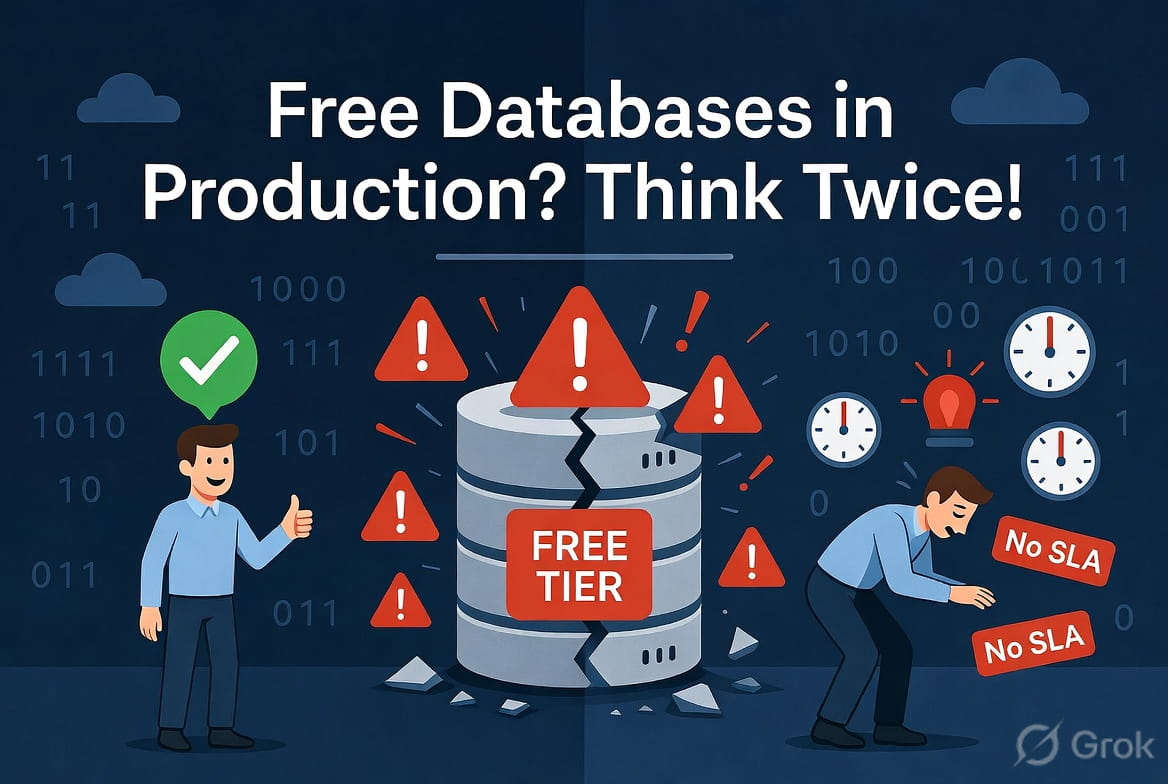
Free online databases sound like a dream come true for developers, startups, and small teams. No setup, no maintenance, instant access, and zero cost. What could possibly go wrong?
A lot.
Using free online (hosted) databases in production is one of the fastest ways to turn a promising project into a reliability nightmare, security disaster, or sudden expensive surprise.
Here’s a brutally honest guide on how NOT to use free online databases when your application is live and serving real users.
1. Don’t Treat Them as Your Primary Production Database
Many free tiers (Supabase free, PlanetScale free, Neon free, Firebase, MongoDB Atlas free, Railway, Render, etc.) market themselves as “production-ready.”
Don’t believe the marketing.
No SLA (Service Level Agreement): Most free plans offer zero uptime guarantees. Your database can go down for hours with no warning and no compensation.
Resource limits that bite hard: You’ll hit row limits, connection limits, storage limits, or query-per-minute caps exactly when your app starts getting traction.
Sudden shutdowns: Many providers automatically pause or delete inactive free projects, or throttle them aggressively.
Correct approach: Use free databases only for development, staging, prototyping, or personal side projects. For production, pay for a proper hosted database or self-host one.
2. Don’t Ignore Data Ownership and Export Nightmares
Free tiers often make it painful to export your data when you need to migrate.
Some providers limit export frequency or size.
Others use proprietary formats that make migration slow and error-prone.
A few have been known to lock data behind paywalls or slow exports deliberately.
Real story: Multiple startups have been stuck paying premium prices just to get their own data out because the free tier export was throttled to a crawl.
Rule: Always assume you will need to leave the free service tomorrow. Test a full data export every month in development.
3. Don’t Rely on Free Tiers for Security & Compliance
Free plans usually come with bare-minimum security:
Shared infrastructure (your data lives next to thousands of others)
Limited or no encryption at rest options
No advanced access controls, audit logs, or compliance certifications (SOC2, GDPR, HIPAA, etc.)
Weaker DDoS protection and rate limiting
If you’re handling user data, payments, health information, or anything remotely sensitive — never use free online databases in production.
4. Don’t Assume “Free Forever” Means Reliable
Free tiers change. Providers frequently:
Reduce free limits
Add new restrictions
Increase pricing dramatically
Deprecate features
What worked perfectly last year can break your app next month without notice.
Example: Several popular free Postgres services have quietly reduced free storage or connection pools over time.
5. Don’t Use Free Databases When You Need Performance
Free tiers are heavily throttled:
Limited CPU and RAM
Slow IOPS (disk performance)
Connection pooling restrictions
Query timeouts enforced aggressively
Your users will experience slow page loads, failed transactions, and timeouts exactly when traffic spikes.
Production needs predictable performance. Free tiers give you unpredictable, best-effort performance.
6. Don’t Forget About Hidden Costs
“Free” often turns expensive in surprising ways:
Egress fees when reading lots of data
Backup and restore costs
Support — good luck getting fast help on free tier
Downtime costs — lost revenue, angry users, damaged reputation
Engineering time spent working around limitations
Many teams end up spending more time and money fighting the free tier than they would have spent on a cheap paid plan.
7. Don’t Use Them for Production Workloads That Matter
Avoid free online databases in production for:
Customer-facing SaaS applications
E-commerce sites
Mobile apps with real users
Any service where downtime = direct revenue loss
Applications handling personal or financial data
Projects you plan to scale beyond hobby level
Acceptable use cases for free databases:
Learning and experimentation
Personal blogs or portfolios
Internal tools with very few users
Open-source demos
Early-stage MVPs (with clear migration plan)
Better Alternatives (Quick Recommendations)
Instead of relying on free tiers for production:
1.Cheap reliable options:
Supabase / Neon / PlanetScale paid starter plans (often $5–25/month)
DigitalOcean Managed Databases
Railway / Render paid instances
Fly.io Postgres
2.Self-hosted (more control):
Postgres on a cheap VPS (Hetzner, Contabo, Linode)
Docker + Postgres
Managed services like AWS RDS (with proper sizing)
3.Serverless options with better free tiers:
Turso (LibSQL) – very generous free tier for edge use
Cloudflare D1 (for specific use cases)
Final Advice: Treat Free as Temporary
The golden rule:
"Free online databases are excellent for development. They are dangerous for production."
Build with free tools to validate your idea quickly. But the moment you have real users, real data, or any expectation of reliability — migrate to a paid or self-hosted solution immediately.
Your future self (and your users) will thank you when the free tier doesn’t suddenly pause your database at 2 AM on a weekend.
What’s your experience? Have you ever been burned by a free database in production? Or are you successfully running on a free tier? Share in the comments!
Tags: Databases, Backend Development, Production Best Practices, Supabase, Postgres, Firebase, MongoDB Atlas
This blog post is meant to save you time, money, and stress. Free is tempting — but in production, reliability almost always beats “free.” Choose wisely.
Enjoyed this article?
Follow us for more tech insights, agency updates and digital trends.