SEO in the Age of AI: Key Technical Terms and the Real Efforts Needed to Succeed in 2026
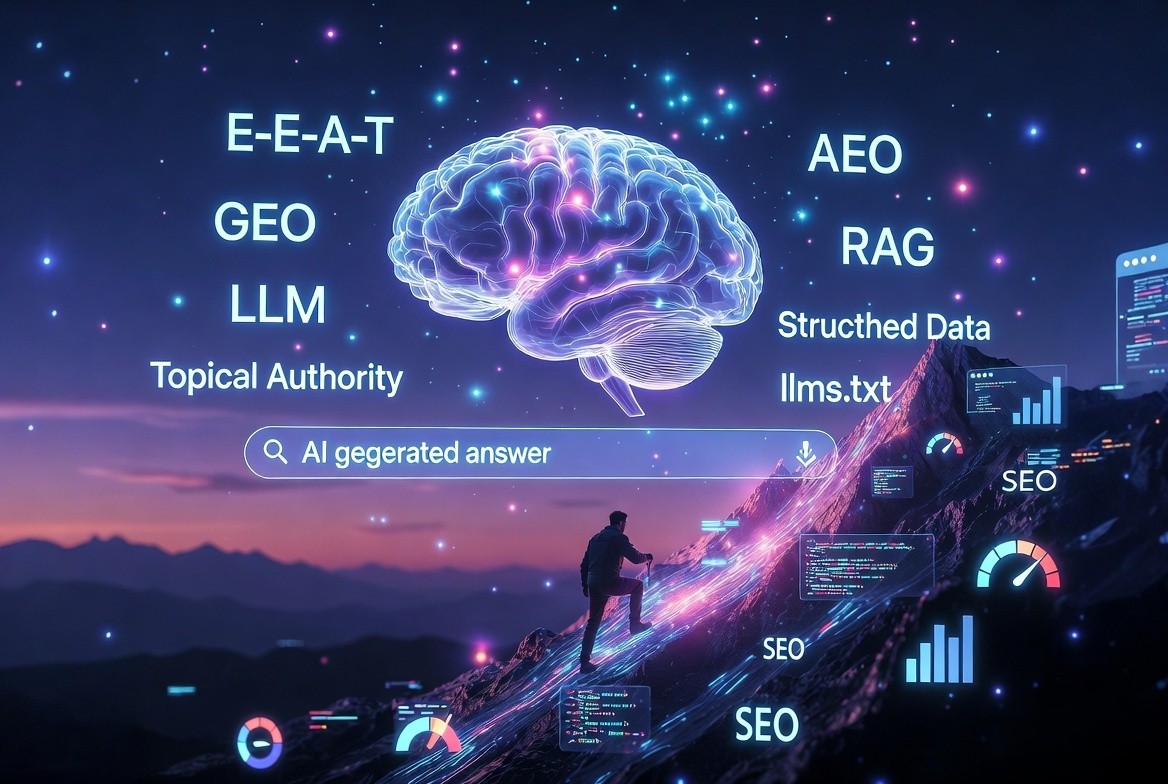
The search landscape has fundamentally changed. Google’s AI Overviews, ChatGPT Search, Perplexity, Gemini, and other generative engines now deliver direct answers instead of just blue links. Traditional SEO tactics like keyword stuffing or basic backlink chasing are no longer enough. In 2026, success demands a blend of proven SEO fundamentals and new AI-specific strategies.
This post breaks it all down: the most important technical terms in AI-driven SEO and the concrete efforts you must invest to stay visible, get cited by AI, and drive traffic and conversions.
1. The Big Shift: From Traditional SEO to AI SEO (GEO + AEO)
Traditional SEO focused on ranking in the “10 blue links” on Google.
AI SEO is about appearing in AI-generated summaries, answers, and conversations. AI engines synthesize information from multiple sources and often cite (or “quote”) the most authoritative, structured, and experience-backed content.
Two new acronyms dominate discussions:
GEO (Generative Engine Optimization): Optimizing content so AI models (LLMs) cite, reference, or quote your brand in their generated responses.
AEO (Answer Engine Optimization): A close cousin of GEO, focused on making your content the perfect “answer” that AI surfaces directly (including in Google’s AI Overviews).
SEO hasn’t died — it has evolved into “Search Everywhere Optimization.” Visibility now spans Google, AI chatbots, voice assistants, and social/search hybrids.
2. Must-Know Technical Terms in AI SEO (2026 Glossary)
Here are the core terms every blogger, marketer, and business owner needs to understand:
E-E-A-T (Experience, Expertise, Authoritativeness, Trustworthiness) Google’s quality framework (expanded from EAT). In the AI era, it’s non-negotiable. AI models heavily favor content that demonstrates real first-hand experience (case studies, experiments), author expertise (bios, credentials), authority (backlinks, mentions, PR), and trustworthiness (accurate sources, transparency, no misinformation).
AI Overviews and LLMs cite E-E-A-T-rich sources far more often.AI Overviews (AIO) / Search Generative Experience Google’s AI-generated summary boxes that appear at the top of results. They pull from top-ranking pages but prioritize clarity, structure, and E-E-A-T. Ranking well in traditional search is now table stakes for AIO citations.
LLM (Large Language Model) The AI technology (e.g., GPT, Claude, Gemini) powering modern search. Understanding how LLMs retrieve and synthesize information is key to GEO.
RAG (Retrieval Augmented Generation) The process LLMs use to pull real-time, up-to-date web data instead of relying solely on training data. This is why fresh, structured content gets cited more.
LLMs.txt A proposed file (placed at yourdomain.com/llms.txt) similar to robots.txt but for AI crawlers. It acts as a “treasure map” for LLMs — highlighting your most important pages, providing summaries, and guiding how AI should (or shouldn’t) use your content. Adoption is growing but still inconsistent; many AI bots don’t fully honor it yet.
Structured Data / Schema Markup Code that helps AI (and search engines) understand your content’s meaning (e.g., FAQPage, HowTo, Article schema). It makes your content far more likely to be extracted into AI answers.
Topical Authority / Entity SEO Building deep clusters of content around a subject so AI recognizes you as the go-to expert on that “entity” (person, brand, topic).
Core Web Vitals & Technical Foundations Page speed, mobile-friendliness, and crawlability remain critical. AI crawlers still need fast, clean sites.
Zero-Click Searches Users get answers without clicking through. Your goal shifts from “driving clicks” to “being the cited source.”
3. The Real Efforts You Must Put In (Practical 2026 Playbook)
AI hasn’t made SEO easier — it’s raised the bar. Here’s what actually moves the needle:
1. Double Down on E-E-A-T Signals
Add detailed author bios with real credentials and links to profiles.
Include first-hand experience (case studies, screenshots, experiments).
Cite sources transparently and update content regularly.
Earn brand mentions, reviews, and PR — AI loves consistent positive sentiment.
2. Create AI-Friendly Content Structure
Start every section with a clear, standalone answer (TL;DR first).
Use short paragraphs, bullet points, numbered lists, and definitions upfront.
Break content into scannable chunks with descriptive headings.
Add FAQ sections and schema markup. AI models extract and reuse concise, well-organized content much more readily.
3. Build Topical Clusters & Entity Authority
Create pillar pages + supporting content that thoroughly covers a topic. Interlink them logically. This signals deep expertise to both Google and LLMs.
4. Technical AI Optimization
Ensure fast load times and mobile-first design.
Implement comprehensive schema markup.
Consider adding an llms.txt file to guide AI crawlers.
Monitor server logs for AI bot activity (Google-Extended, GPTBot, etc.).
Keep product feeds, inventory, and data fresh — AI loves real-time accuracy.
5. Optimize for Conversational & Intent-Driven Queries
Target natural-language, long-tail questions people actually ask AI chatbots. Focus on user intent over exact-match keywords.
6. Use AI Tools Wisely — But Keep Humans in Charge
AI can help with research, outlines, and editing — but final content must be original and experience-backed. Pure AI-generated content without human oversight rarely ranks or gets cited well.
7. Track What Matters Now
Monitor AI citations (tools like Semrush, Ahrefs, or specialized AI visibility trackers).
Measure brand mentions across ChatGPT, Perplexity, Gemini, etc.
Track traditional rankings and zero-click impact.
8. Diversify Beyond Google Optimize for multiple platforms — Perplexity, ChatGPT Search, and emerging AI search engines. Strong E-E-A-T and clear content work everywhere.
Conclusion: SEO Is Alive — But It Demands More
In 2026, the winners won’t be the ones gaming algorithms. They’ll be the ones who create genuinely helpful, experience-rich, clearly structured content that AI (and humans) trust.
Start small: audit your top pages for E-E-A-T signals and restructure one piece of content using the “answer-first” model. Add schema. Build one new topical cluster. The compounding effect will be massive.
The age of AI search rewards quality, clarity, and authority more than ever. Put in the effort now, and you won’t just rank — you’ll become the source AI recommends.
What’s one change you’re making to your SEO strategy this year? Drop it in the comments — I’d love to hear your plans!
Enjoyed this article?
Follow us for more tech insights, agency updates and digital trends.