Why You Should Integrate Monitoring Tools Like New Relic from Day One When Building Your Product
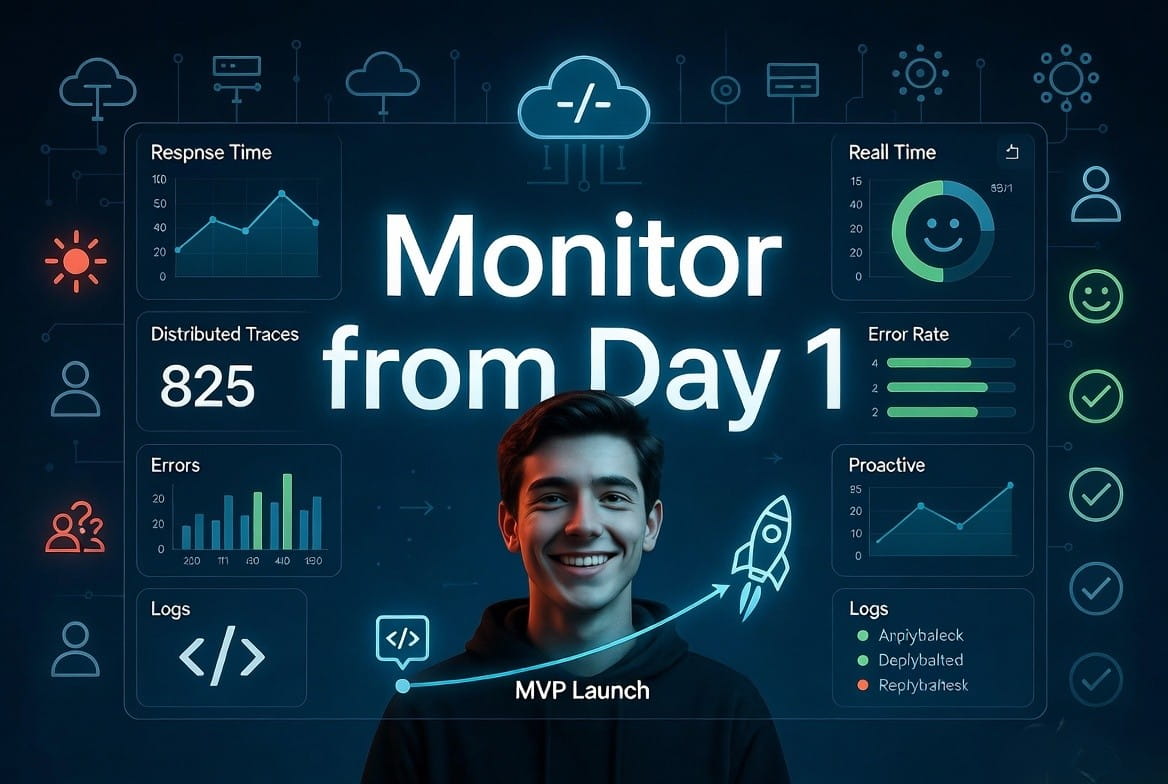
In the rush to launch an MVP, most founders and engineering teams prioritize features, user flows, and shipping code. Monitoring? It often gets pushed to “later, when we scale.”
But here’s the harsh reality: that “later” almost always arrives with a 3 a.m. pager storm, angry customers, and a mounting bill for emergency fixes.
According to recent data, unplanned IT outages now cost businesses a median of $33,333 per minute—and $76 million annually for the average organization. Small and mid-sized teams aren’t spared either; downtime can easily run $127–$427 per minute in labor and lost revenue alone.
The good news? Tools like New Relic, Datadog, Sentry, Prometheus + Grafana, and OpenTelemetry-based platforms make full-stack observability accessible from day one—often at zero or near-zero cost thanks to generous free tiers.
Here’s why smart product teams treat monitoring as a non-negotiable foundation, not an afterthought.
1. You Catch Problems Before Your Users Do (Proactive vs. Reactive)
Without observability, your first real feedback is usually a flood of support tickets or a sudden drop in conversion rates.
With APM (Application Performance Monitoring) and full-stack observability in place from day one:
You get real-time visibility into response times, error rates, database queries, third-party API latency, and memory leaks.
Distributed tracing lets you follow a single request across microservices in seconds.
Alerts fire before customers notice.
New Relic, for example, lets teams go from symptom to root cause in minutes by correlating traces, logs, and metrics in one unified view. Teams that adopt observability early routinely slash mean-time-to-detect (MTTD) and mean-time-to-resolve (MTTR) by 50–85 %.
2. You Build Performance Baselines and Make Data-Driven Decisions
Day-one monitoring gives you historical context from the very first user.
You instantly know:
What’s “normal” traffic and latency for your app.
Which endpoints are slowest under load.
How usage patterns evolve as you add features.
This baseline becomes gold when you’re deciding whether to scale infrastructure, refactor code, or kill underperforming features. Without it, you’re flying blind—guessing at capacity planning and burning money on over-provisioned cloud resources.
3. You Save Serious Money (Fix Early = Fix Cheap)
The cost of fixing a performance issue grows exponentially the later it’s discovered:
| Stage | Relative Cost to Fix | Why |
| Development / Staging | 1× | Quick code change |
| Production (early) | 5–10× | Affects few users |
| Production (post-launch) | 50–100×+ | Downtime, lost revenue, engineering fire drills |
Early monitoring also helps optimize cloud spend. New Relic and similar tools highlight inefficient queries, over-fetching, and idle resources that quietly inflate your AWS/GCP bill. Many startups report 20–40 % cloud cost savings simply by acting on observability data they collected from week one.
4. You Improve Developer Velocity and Happiness
Nothing kills velocity faster than “it works on my machine” debugging sessions that stretch into weekends.
With observability baked in:
Engineers spend less time reproducing bugs.
Deployments become safer (you can compare performance before/after).
On-call rotations are less painful.
New Relic’s developer-friendly workflows are specifically designed so engineers can jump from a slow transaction straight into code-level insights and related logs—without switching between five different tools.
5. Security, Compliance, and User Trust Become Built-In Advantages
Anomalous behavior (sudden spikes in failed logins, unusual data-access patterns) shows up immediately. You can set alerts for security-relevant events and maintain audit-ready logs from the start—crucial for SOC 2, GDPR, or HIPAA down the road.
Customers today expect 99.9 %+ uptime. Having monitoring proof in your pitch deck or post-mortem reports builds trust with investors and enterprise buyers alike.
6. You Future-Proof Your Architecture for Scale
The architecture that works for 100 users rarely works for 100,000. Monitoring from day one reveals exactly when and where you need caching, sharding, rate limiting, or service splitting—before you’re forced into a painful migration.
How to Get Started on Day One (It’s Easier Than You Think)
1. Choose the right tool for your stage
New Relic: Excellent free tier (100 GB ingest/month + 1 full user forever), strong APM, OpenTelemetry support, and consumption-based pricing. Ideal for startups and polyglot teams.
Datadog: Powerful but can get pricier at scale.
Open-source combo (Prometheus + Grafana + Loki + Tempo) if you want full control and zero licensing cost.
Sentry for error tracking + performance if you’re frontend-heavy.
2. Instrument in minutes
Most modern tools offer one-line SDK installs or auto-instrumentation for Node.js, Python, Java, Go, .NET, etc. Add the agent to your Dockerfile or CI/CD pipeline on day one.
3. Start small, iterate
Monitor your core API and database first. Add frontend RUM (Real User Monitoring), infrastructure, and logs as you grow. No need for 100 % coverage on launch day.
4. Set smart alerts
Focus on business metrics (e.g., checkout completion rate, API error budget) rather than raw CPU spikes.
Common Objections—and Why They’re Wrong
“It’s too expensive for an early-stage product.”
New Relic’s free tier and usage-based models mean most startups pay literally $0 for the first several months or even years.
“We’ll add it later when we have users.”
By then you’ll have technical debt, no baselines, and a stressed team. The cost of retrofitting observability into a live product is dramatically higher.
“We’re just an MVP—nothing can break.”
Famous last words. Every successful product eventually hits scale, traffic spikes, or third-party outages.
Final Thought
Building a product without monitoring is like driving a car with the dashboard covered in tape. You might reach your destination once or twice by luck—but you’ll never know how close you came to crashing, how much fuel you’re wasting, or when the engine is about to seize.
The teams that ship reliably, iterate faster, and delight users from day one aren’t necessarily smarter or luckier. They simply decided early that visibility is a feature, not a luxury.
If you’re building something new right now, stop what you’re doing for 30 minutes and add observability today. Your future self—and your users—will thank you.
What’s your biggest monitoring pain point right now? Drop it in the comments—I’d love to hear how you’re solving (or planning to solve) it.
shopping_bag Recommended Resources
Enjoyed this article?
Follow us for more tech insights, agency updates and digital trends.