AI Everywhere, Value Nowhere: How Companies Are Slapping "AI" Labels on Products Just to Empty Your Wallet
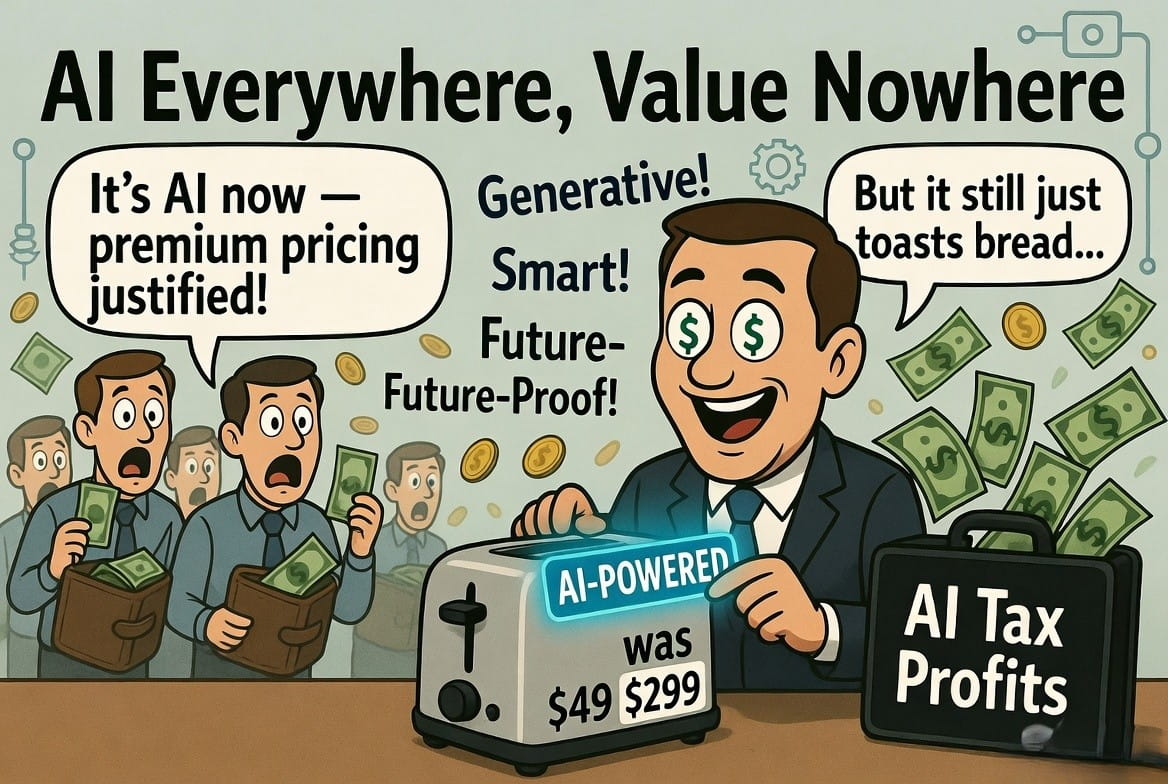
The AI hype is real—but so is the "AI tax."
You're seeing it in your software subscriptions, your gadgets, even your fridge. Companies are rushing to add "AI-powered" features that solve problems you never had, then charging you extra for the privilege. It's not innovation. It's AI washing—the tech world's version of greenwashing—where buzzwords drive profits, not progress.
And the worst part? It's working. SaaS prices have jumped 20-37% in many cases under the guise of "AI investment," even when the new features feel like bloat.
Let's call it what it is: a cash grab.
What Exactly Is AI Washing?
AI washing happens when companies exaggerate, misrepresent, or outright fake AI capabilities to seem cutting-edge. They rebrand basic automation, rules-based tools, or even human labor as "intelligent" AI. The goal? Higher valuations, investor dollars, and—most importantly—premium pricing from you, the customer.
It's everywhere:
Simple sensors in gadgets rebranded as "smart AI."
Chatbots tacked onto old software.
Vague marketing claims with zero technical details.
The SEC has already cracked down on investment firms for false AI claims, and more scrutiny is coming.
Big Tech's Favorite Money Printer: Forced AI Subscriptions
Remember when software just... worked? Now it comes with mandatory AI upsells.
Microsoft Copilot: The company aggressively bundled it into Microsoft 365 subscriptions, contributing to ~5-6% effective price hikes. It popped up everywhere in Windows 11 (Photos, Notepad, Snipping Tool—you name it). Users hated the intrusion and low usefulness. Microsoft's own response in 2026? Quietly scaling back "unnecessary" Copilot entry points because almost nobody was using it productively. Yet you're still paying for it.
Adobe Creative Cloud: In 2025, they hiked All Apps pricing (up to $10-15/month or $120/year) and pushed a new "Pro" tier loaded with generative AI credits. Lower tiers got severely limited AI access. Creators weren't asking for more AI—they were asking for stable tools without the subscription trap. The backlash was immediate and brutal.
Salesforce, Notion, and others: Similar story—6%+ base price increases "tied to AI innovation," with features gated behind higher tiers. One analysis called it the "AI tax": prices rising faster than actual value delivered.
Microsoft even updated Copilot's terms to say it's "for entertainment purposes only" and "don't rely on it for important advice." They're pushing AI hard... while admitting it's not ready for real work.
Consumer Gadgets: AI in Your Toaster (Because Why Not?)
It's not just enterprise software. Walk into any store and you'll find:
"AI-powered" refrigerators that just send door-open alerts (that's a timer, not intelligence).
Smart lamps that dim based on time of day (basic conditional logic).
Even "AI" dog bowls or toasters that do exactly what non-AI versions do—but cost more.
These aren't solving problems; they're solving marketing briefs. Companies know "AI" in the product description moves units and justifies premium pricing.
Worse cases of outright deception:
Amazon's Just Walk Out stores: Marketed as pure AI vision tech. Reality? Heavy reliance on human reviewers in India for most transactions.
Builder.ai: Raised hundreds of millions claiming AI-built apps. Investigation revealed... outsourced human developers doing the work.
Coca-Cola's AI-co-created drink: Vague claims with no real explanation of AI's role—just hype to sound innovative.
Why This Matters (and Why It's Getting Worse)
Companies do this because it works short-term:
AI hype boosts stock prices and funding rounds.
It lets them raise prices without adding proportional value ("We're investing in the future!").
Adding a superficial chatbot or label is cheap compared to real R&D.
But the backlash is here. Users are ditching bloated tools, regulators are watching, and even Microsoft is quietly walking back its overreach. AI bloat creates technical debt, frustrates customers, and erodes trust.
How to Fight Back as a Consumer
Don't let them pick your pocket. Next time you see "AI-powered":
1.Ask the hard questions: Is this truly machine learning, or just a rule-based script with a new name?
2.Check the value: Does it solve a real pain point, or is it a gimmick?
3.Vote with your wallet: Choose non-AI alternatives when available (many apps still offer "classic" tiers). Read independent reviews before upgrading.
4.Demand transparency: Support companies that add AI only where it genuinely improves things—not everywhere.
The next time a SaaS tool emails you about "exciting new AI features" and a price increase, hit unsubscribe—and find a better option.
What do you think? Have you been burned by an unnecessary AI "upgrade"? Drop your stories in the comments. And if you're a company leader reading this: Real innovation wins customers. Cheap AI labels lose them.
shopping_bag Recommended Resources
Enjoyed this article?
Follow us for more tech insights, agency updates and digital trends.