Avoiding the Framework Frenzy: How to Build a Strong Foundation One Day at a Time
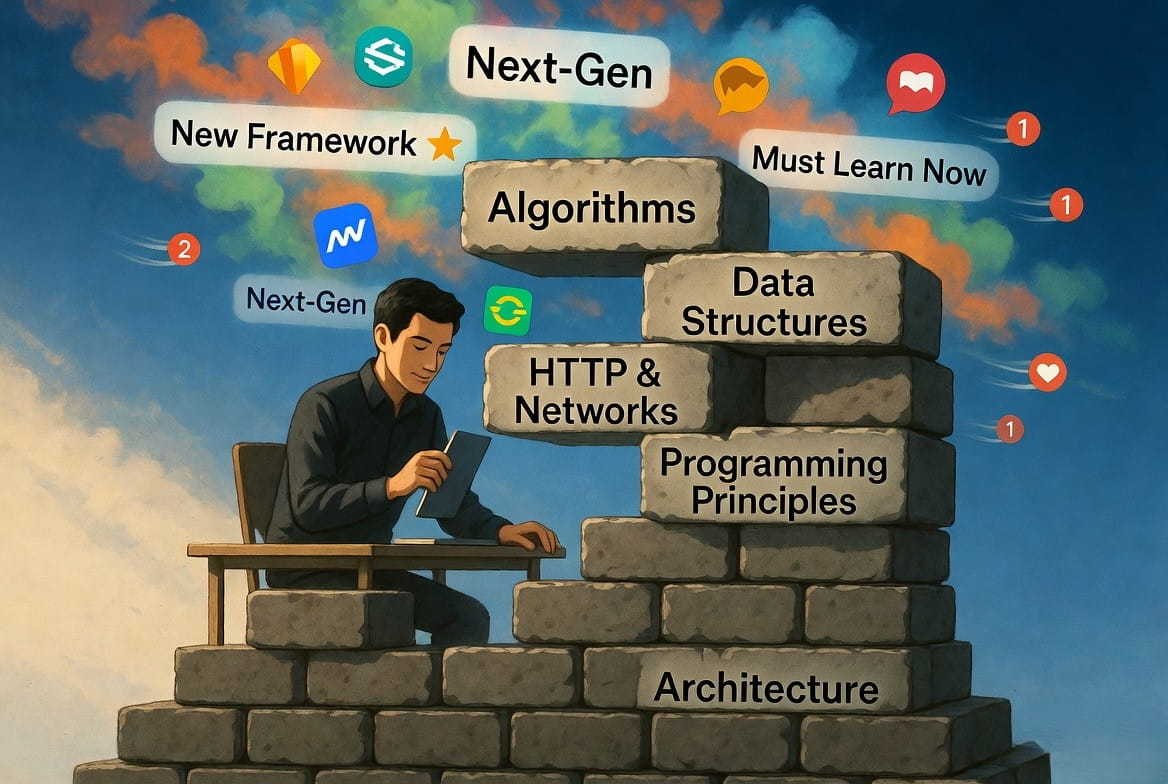
Avoiding the Framework Frenzy: How to Build a Strong Foundation One Day at a Time
In the world of software development, it feels like every Monday brings a shiny new framework promising to solve all your problems. One week it's a revolutionary reactivity system. The next, it's an AI-powered build tool or a "next-gen" meta-framework that claims to make everything faster, simpler, and more scalable.
Sound familiar? Welcome to framework fatigue — that overwhelming noise of hype cycles, Twitter (X) threads, Reddit rants, and "you need to learn this NOW" blog posts.
If you're a developer — junior or senior — you've probably felt the pull: the fear of missing out (FOMO) that makes you jump from tutorial to tutorial, never quite feeling "caught up." The result? Shallow knowledge, burnout, and a resume full of half-learned tools that become obsolete in six months.
The good news? You can tune out 99% of the noise and build a rock-solid foundation that lasts a career. It doesn't require superhuman willpower — just consistent, intentional habits. Here's exactly how to do it, day by day.
Why the Noise Exists (and Why It Hurts You)
New frameworks launch constantly because:
-The web (and software in general) evolves rapidly.
-Open-source contributors and companies want attention, funding, and adoption.
-Marketing works: "The framework that React is scared of" gets clicks.
But chasing every launch has real costs:
-Tutorial hell: You learn syntax but never understand why things work.
-Unstable skills: Frameworks come and go (remember AngularJS? jQuery dominance?).
-Decision paralysis: You spend more time evaluating tools than shipping code.
-Burnout: Constant learning without deep mastery leads to imposter syndrome.
The truth most "hype influencers" won't tell you: The best engineers aren't the ones who know the most frameworks. They're the ones who deeply understand the fundamentals and can adapt to anything.
Step 1: Filter the Noise Ruthlessly
1. Adopt a "Problem-First" Mindset
Stop asking, "What's the newest framework?" Start asking, "What problem am I actually trying to solve?"
-Need a fast UI? Master vanilla JavaScript, DOM manipulation, and basic state management first.
-Building APIs? Nail HTTP, REST/GraphQL principles, databases, and authentication before picking Express, FastAPI, or whatever's trending.
New tools are just abstractions. Once you understand the layer underneath, picking up a new one takes days, not months.
2. Master the Timeless Fundamentals (Your Non-Negotiable Core)
Dedicate your learning energy here before touching any new framework:
| Area | Why It Matters | Daily Practice Tip |
| Programming Language (JS/Python/etc.) | Everything builds on this | 30 mins deep dive into one concept |
| Data Structures & Algorithms | Core problem-solving | One LeetCode/easy problem |
| HTTP, Networks, Security | How the web actually works | Read one MDN article |
| Databases & Persistence | Data is everything | Practice simple queries |
| Design Patterns & Architecture | Scalable, maintainable code | Refactor one piece of old code |
These don't change weekly. They compound daily.
3. Curate Your Information Diet
Unfollow the hype machine: Mute accounts that only post "New framework drop 🔥". Follow pragmatic voices who talk principles (think articles from Kent C. Dodds, Addy Osmani, or long-form technical blogs).
Time-box exploration: Give yourself one "Friday afternoon experiment" slot per month. Try the new thing then — not when it launches.
Use the 30-day rule: If a framework is still relevant and gaining real traction after 30 days (check GitHub stars, job postings, and production use cases), then evaluate it seriously.
4. Build Real Projects, Not Demo Apps
The fastest way to kill noise? Ship something useful with what you already know.
Start small:
Clone a simple app (todo list → full CRUD dashboard) using only fundamentals.
Then add one tool at a time because you need it, not because it's trending.
Refactor it later when you learn something new. This builds intuition faster than any tutorial.
Step 2: Build Your Foundation Day by Day
Consistency beats intensity. Here's a realistic daily system that fits around a full-time job or life:
Your 30-Minute Daily Foundation Routine
10 minutes — Deep work on fundamentals (no frameworks allowed).
10 minutes — Code something real (even 10 lines).
10 minutes — Reflect: What did I learn? What problem did I solve?
Weekly Habits That Scale
Monday: Review last week's code. Refactor one thing for better architecture.
Wednesday: Read one chapter or deep-dive article on core CS/web concepts (no hype posts).
Friday: 1-hour "play time" — experiment with one new tool only if it solves a real pain from your projects.
Weekend: One bigger project milestone (deploy something, write a short note on what you learned).
Track it simply — a Notion page, GitHub repo, or even a paper notebook titled "My Foundation Log." Seeing progress over weeks is incredibly motivating.
When Should You Learn a New Framework?
Only when it meets all three criteria:
It solves a specific, painful problem in your current project.
You've already tried solving it with fundamentals (and hit a wall).
It has real staying power (mature ecosystem, strong community, used in production by respected teams).
The Long-Term Payoff
Developers who build strong foundations:
Switch jobs or stacks effortlessly.
Debug faster and architect better systems.
Actually enjoy learning new tools (because they understand them).
Stand out in interviews and real-world projects.
The noise will never stop. But your ability to ignore it and keep building? That grows stronger every single day.
Final Challenge
Today, close all tabs about the "latest framework."
Open your code editor.
Pick one small feature in a personal project or even a brand-new vanilla HTML/JS file.
Build it using only what you already know deeply.
Then write one sentence in your foundation log: "Today I built X without chasing Y."
Do that tomorrow. And the day after.
In six months, you'll look back and wonder why you ever felt overwhelmed.
You've got this. The foundation is built one intentional day at a time.
What’s one fundamental you’re committing to this week? Drop it in the comments — I’d love to hear your plan.
Stay focused. Ship consistently. Ignore the noise. 🚀
Enjoyed this article?
Follow us for more tech insights, agency updates and digital trends.